
Album Reviews
Review: The Swellers – “The Light Under Closed Doors”
The Swellers – “The Light Under Closed Doors”
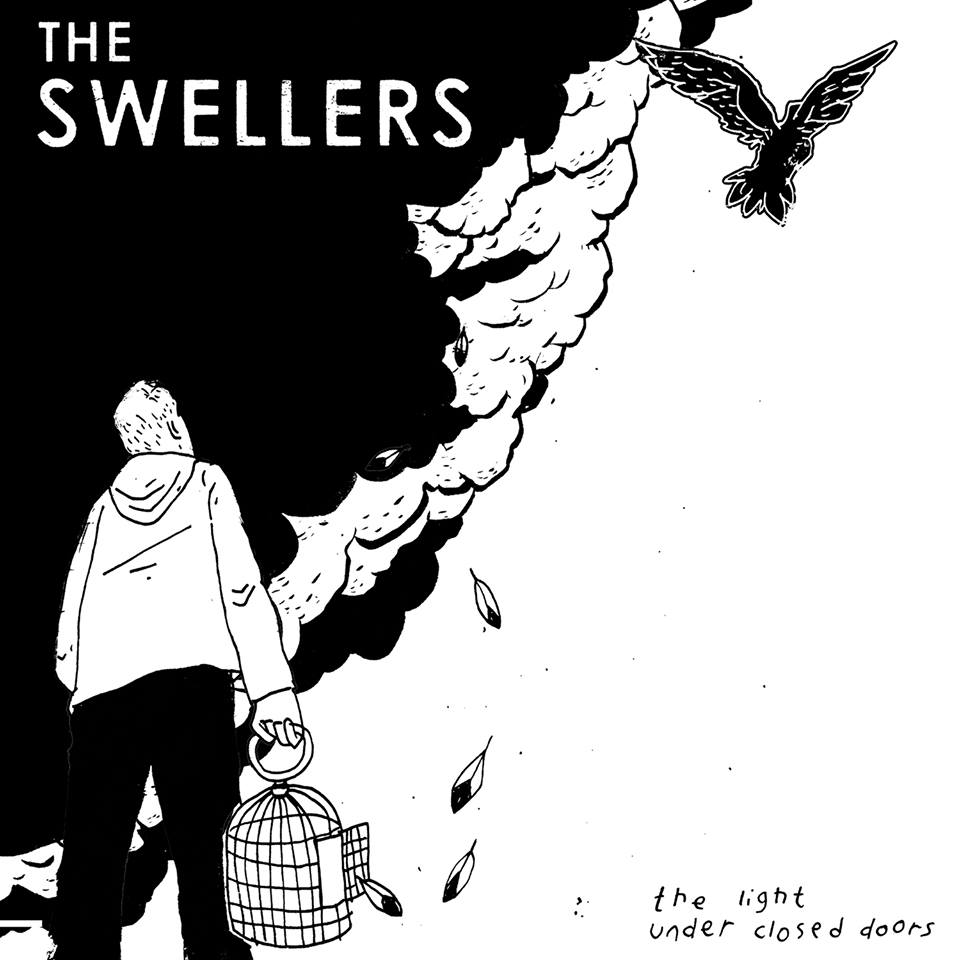
Released: October 29, 2013
Label: No Sleep Records
Purchase: Digital | Vinyl | CD
The Swellers have been a staple in the punk scene for quite some time now, famous for releasing their incredible 2009 album Ups and Downsizing. The Michigan outfit have been criticized a little on signs that they were following the trend towards pop, but their recent album The Light Under Closed Doors, released just last week, has put those suspicions back in the closet. The Light Under Closed Doors demonstrates that the sound that people fell in love with is still there–and still strong.
The album gives a lot to laud about. As per usual, the new album’s lyrics are just as defining as ever, employing the classic “internal tension and melancholy” theme with catchy hooks, inducing the pop punk-esque ambivalent beauty and angst that The Swellers have expressed so well in the past. The riffs and melodies are catchy and engaging–definitely something worth dancing to (or, for the softcore, bobbing your head to). The juxtaposition between (comparatively) slower, more melody-driven songs like “Friends Again (We Can’t Be),” “Designated Driver,” and “High/Low,” and more gung-ho, in-your-face tunes like “Call It A Night,” “Big Hearts,” and “Great Lakes State” are also great. Even the questionable quality of the album, usually a negative feature on a studio recording, seems to paradoxically add to the album, giving a feeling of homeliness and intimacy, as if the songs were being performed on stage.
To be honest, there really isn’t much that detracts from the album. Those unfamiliar with heavier genres could probably note that the “wave of sound” in The Light Under Closed Doors is overwhelming and too uniform; also, very staunch fans of The Swellers could, imaginably, compare this as still being in the shadow of Ups and Downsizing. However, as long as you’re interested in the overarching punk genre at all, you won’t regret taking a listen to this at all. In fact, you might just be like me and love it.
9.0
Standout tracks: “Big Hearts,” “Got Social,” “Call It A Night,” “Becoming Self-Aware”
Track listing:
01. Should
02. Big Hearts
03. Got Social
04. High/Low
05. Great Lakes State
06. Becoming Self-Aware
07. Friends Again (We Can’t Be)
08. Designated Driver
09. Favorite Tune
10. Call It A Night
Review: Yellowcard – “Ocean Avenue Acoustic”
Yellowcard – “Ocean Avenue Acoustic”

Released: August 13, 2013
Label: Hopeless Records
Purchase: Digital | CD
Pop punk band Yellowcard have been considered by many to be one of the most iconic pop punk bands of the new millennium, their powerful melodies and catchy choruses taking the country by storm. The same people almost all agree that their 2003 album Ocean Avenue is their most memorable work; songs such as Only One, Breathing, Back Home, and (of course) the title track itself topped the playlists of our childhoods. And to celebrate its 10 year anniversary, the band have decided to release a “re-imagining” of all thirteen Ocean Avenue tracks in a new acoustic album–a piece of art that invokes both nostalgia and innovation.
One of the most impressive features of Yellowcard songs has always been the inclusion of the violin (thanks to Sean Mackin), a long-considered classical instrument that meshed perfectly with the band’s modernized songs. Ocean Avenue Acoustic continues to masterfully use this amazing instrument, from the strong notes in the beginning of Believe and in the chorus of Breathing to the much more reserved but equally impactful tunes in Only One and Empty Apartment. All in all, the violin that got us loving Yellowcard in the first place does not disappoint in the new album and continues to add strength to each song.
Regarding the songs themselves, Yellowcard manages to create a new breed of intensity in some of their more explosive songs. The sound of the acoustic Way Away is just as enormous as its older counterpart, but in a different way; while there isn’t as much overwhelming noise that highlights pop punk, the speed and brawn of the acoustic instruments evoke a sense of desperation and excitement that is just as empowering as the feelings received from the original 2003 version. The same can be said for Miles Apart, Life of a Salesman, View From Heaven, and Ocean Avenue itself. And on the other side of the spectrum, emotionally riveting tracks such as Only One, Back Home, and Empty Apartment have become even more moving. Their softer melodies paint the message of their songs, whether it’s loss of love or the falsity of an expectation, in a way that feels even more genuine and true than before.
Holistically, Ocean Avenue Acoustic takes thirteen amazing songs and alters their sounds to make dissimilar but equally powerful songs. Not only do the songs lend heavy doses of nostalgia and remembrance for the songs that help define a decade, they feel refreshing and new when one listens to them. Overall, this album, being both the same and different as the groundbreaking album ten years ago of the same name, deserves a rating equivalent to the original Ocean Avenue.
9.5
Standout Tracks: “Back Home,” “Only One,” “Empty Apartment,” “Breathing,” “Miles Apart,” “Ocean Avenue”
Track listing:
01. Way Away (Acoustic)
02. Breathing (Acoustic)
03. Ocean Avenue (Acoustic)
04. Empty Apartment (Acoustic)
05. Life Of A Salesman (Acoustic)
06. Only One (Acoustic)
07. Miles Apart (Acoustic)
08. Twentythree (Acoustic)
09. View From Heaven (Acoustic)
10. Inside Out (Acoustic)
11. Believe (Acoustic)
12. One Year, Six Months (Acoustic)
13. Back Home (Acoustic)
Review: One Hundred Year Ocean – “Where Were You While We Were Getting High?”
One Hundred Year Ocean – “Where Were You While We Were Getting High?”
Released: July 8, 2013
Label: Broken World Media
Purchase: Digital | Pre-Order Vinyl Available Soon
One Hundred Year Ocean officially today release their new four track EP Where Were You While We Were Getting High?. Oasis fans unite! Based out of Willimantic, CT, OHYO is the solo work of Derrick Shanholtzer-Dvorak from TWIABP. The band is “usually made up of close friends and weirdos” and creates an indie rock emo sound with musical influences such as Modest Mouse, The Hold Steady, and Cursive. The EP was recorded by Chris Teti at Silver Bullet Studios in Burlington, CT and mastered by Jon Markson.
The first track on the EP titled Hospital Town, is a slower paced with a long repetitive intro leading to melancholy filled lyrics thematically about giving up. The refrain “I hope there is a hell / and I hope we don’t forget to lose it all” gives off an eerie tone with a slight glimmer of hope. Soco Amaretto Bud Light Lime, the second song, which I hope is in reference to the Brand New track, picks up the pace of the EP. Quick twinkly indie melodies and two verses containing philosophical questions and obscure nature imagery portrays the adeptness of this outfit at songwriting. The track then leads nicely into a Modest Mouse sounding instrumental bridge with a medley of synthesizer, guitar and percussion before closing out.
In Apples, the trumpet leads the start of the track with the drums and guitar following. For some reason, I just love OHYO‘s use of the trumpet in this EP it just seems to fit seamlessly. Lyrically, I really hope the band members don’t drink each other’s urine, but if that’s the secret behind these songs, then maybe more bands should be drinking each other’s piss. Despite the short length of this track, just above one minute, it’s one of the more cheery numbers with lines such “Don’t worry about the rent, this month isn’t over yet.” and “We were electric like the summer / And I said to my brother / ‘Next Halloween let’s be each other and stay that way forever'” providing a sense of optimistic realism.
The last track, Magnetic Curses is a personal favorite on the release, combining the beloved trumpet and Derrick Shanholtzer-Dvorak’s lyrical mastery. With a crescendo leading to “So where is our hope? / Or when do we get paid? /’cause I’ve been so broke” and a wail of emotion, it brought me back to that tear-jerking scene in 50/50 where Joseph Gordon-Levitt loses it in the car. This song is self-deprecating just without the humor, but it speaks to the listener and creates the mood that not many other genres can.
With more mature songwriting and a refined sound, delving into various corners of indie, emo, and pop Where Were You While We Were Getting High? is definitely worth a listen and is one of my favorite releases this year so far. Streaming now on their Bandcamp with pre-orders of a one sided 12″ available later from Broken World Media pick this album up. There is a name your price basis download here. For more information check out their Facebook and catch them on their US tour starting in August.
Standout Tracks: “Soco Amaretto Bud Light Lime”, “Magnetic Curses”
9.0
Track Listing:
1. Hospital Town
2. Soco Amaretto Bud Light Lime
3. Apples
4. Magnetic Curses
Review: Nations Afire – “The Ghosts We Will Become”
Nations Afire – “The Ghosts We Will Become”
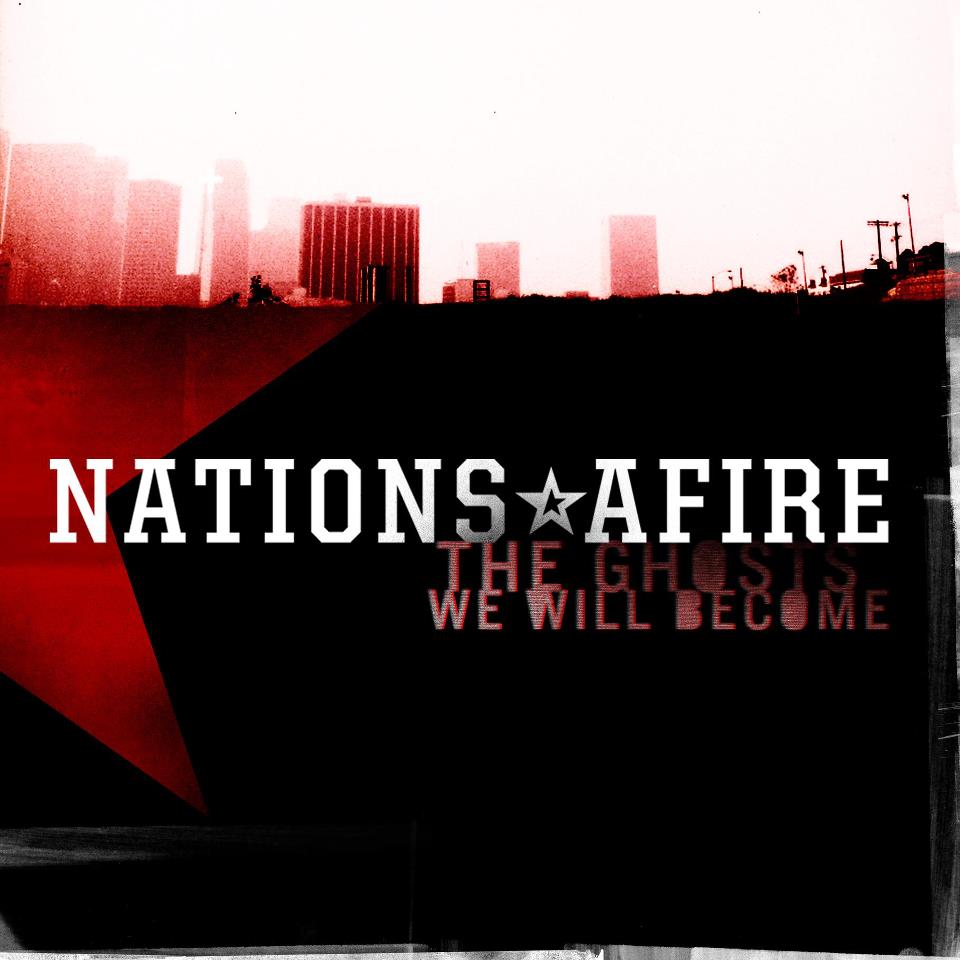
Released: July 2, 2013
Label: Hardline Entertainment
Purchase: Digital | CD
Nations Afire, an ensemble composed of music veterans from the groups Rise Against, Death Stereo, and Ignite, have recently released their debut album, The Ghosts We Will Become. No stranger to their music scene in California, the rock band seeks to spread their sound to a national–and global–level.
And perhaps that goal isn’t without reason either; with strong riffs and vocalist Nik Hill’s powerful, rough vocals (somewhat reminiscent of less nasal-y version of Alter Bridge‘s Myles Kennedy’s singing voice) that blend together well, nearly every song in the album possesses the headbanging energy people want. The songs without the hard rock gusto are no slouch either, instead choosing a more emotional approach, from comparatively heavy Nine Lives to entirely acoustic Even The Blackest Heart Still Beats.
Certain parts of the album, however, are weak. “I am an army coming through/I am a zombie over you/I can’t believe it, I want it so bad” in I Am an Army feels almost half-assed, and the opening line “And the wolves cry out again” in Wolves’ chorus seems to always drop the energy of an otherwise consistent song. Another issue with The Ghosts We Will Become is that it sounds too similar to the punk rock and hard rock scene. The beginnings of I Am an Army and One Perfect Day, for example, sound just like an intro from a song by Rise Against. The lyrics also read similar to Rise Against or Anti-Flag. Although the sound itself is more than satisfying, there aren’t any curve balls or segments that stand out as unique, which makes the album sit in the shadow of already established bands of the same genre.
Nevertheless, as a band’s debut album, The Ghosts We Will Become is a very strong start, and it is a positive indicator of Nations Afire’s talent and where it can go from here. As long as the band continues to develop their own sound and find its niche in the wildly popular rock genre which they jump into, it will no doubt end up in the spotlights.
7.5
Standout Tracks: “Occams Razor,” “Even The Blackest Heart Still Beats,” “Pick Up The Pieces”
Track listing:
01. I Am an Army
02. The Ghosts We Will Become
03. Nine Lives
04. One Perfect Day
05. In Absentia
06. Occams Razor
07. Even the Blackest Heart Still Beats
08. Pick Up the Pieces
09. Break Your Fall
10. The Legacy We Leave
11. The Concussionist
12. Wolves
Review: Liger Tea Party – “Sorry, We Aren’t Great”
Liger Tea Party – “Sorry, We Aren’t Great”
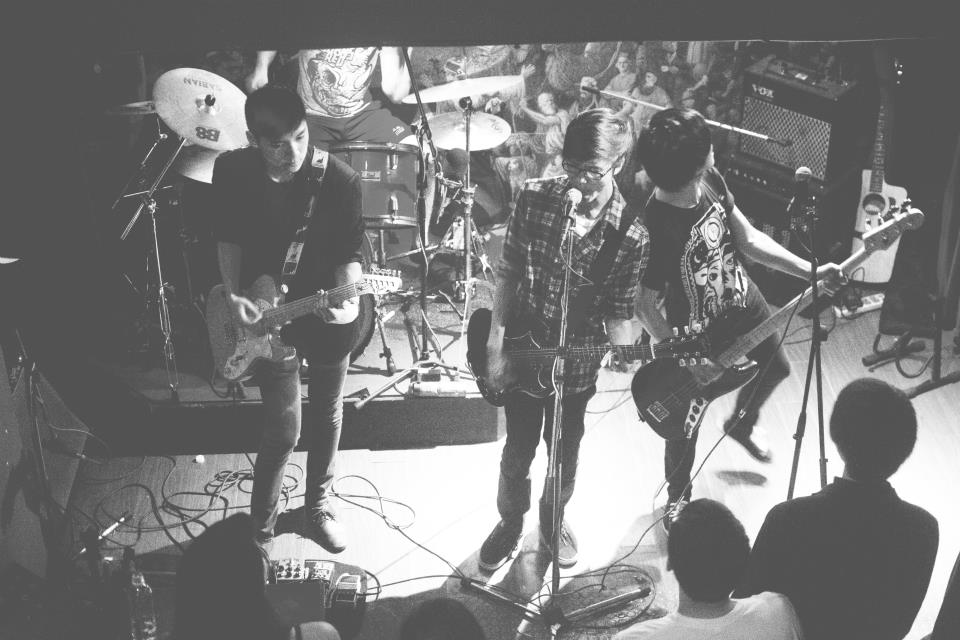
Released: June 23, 2013
Label: Unsigned
Purchase: Digital
Liger Tea Party is an unsigned band from Shanghai, China composed of clean vocalist/guitarist Dawson Chen, guitarist Charles Wang, drummer Edward Pan, and bassist/unclean vocalist Keith Yeo. The band just released their debut EP, Sorry, We Aren’t Great, but the members of the band have been in the Shanghai music scene for years in various different outfits. Sporting a sound that is hybrid of pop punk and hardcore (similar to A Day To Remember), Liger Tea Party has already rocked many venues around Shanghai, and their charismatic energy is familiar to their fans.
The EP itself is a current collection of their complete songs recorded at Dbstudios Shanghai. They possess a strong upbeat atmosphere that rivals veterans like All Time Low and The Wonder Years, with addictive crowd-pleasing chants. The unclean vocals are also, almost surprisingly, welcoming and a sublime addition to each song. Finally, their lyrics aren’t bad at all, definitely not reminiscent of some of the shallow writing present in certain contemporary artists, including some bands in the same relative genre. Our Editor-in-Chief, Harri Gibson, when asked about Liger Tea Party stated, “Damn, this band is a dream!”
The problem keeping Liger Tea Party‘s songs from being perfect in Sorry, We Aren’t Great seems to be the fusion of the vocals. In the EP, there are three voices who perform at different points, and while they are all unique individually, none of them appear to befit the songs’ instrumentals incredibly well. Similarly, in the EP Dawson’s clean vocals don’t mesh perfectly with Keith’s screams but that could be corrected easily and definitely isn’t evident in their live shows. The overall result is massive potential that screams to be better. The songs are incredibly good and very much worth a listen if you are into positive energy and gung-ho music. Stream the songs below and check out their Facebook page.
Standout Tracks: There’s only three, listen to them all!
7.5
Review: We Are Monroe – “Self Titled EP”
We Are Monroe – “Self Titled EP”
Released: January 14, 2013
Label: Unsigned
Purchase: Digital
The Montreal based band, We Are Monroe at the start of this year released their self-titled EP. It opens up with the track, Give Me Some… which right off the bat demonstrates their signature style of commanding vocals and post-punk guitar work. The fast paced guitar riffs and bass licks accompanied by frontman, Pat Gomes’ vocals create a catchy tune. Next up is Modern Day Gentlemen, stylistically similar to songs by Interpol and The Bravery, allows the listener to really understand and identify with the intricate melodies and percussion encompassing of the genre. The powerful vocals in the chorus highlight the undeniable passion for music that the band has. At times the pace is picked up, but this calmer listen really supplements the rest of the EP.
The third track, Old Orchard once again demonstrates the post-punk rock component of the band. It’s a personal favorite of mine, as you can fully hear the range of the vocalist, and each instrumental component is perfectly crafted to create a coherent standout track. Finally on the EP, there is Tear Yourself Apart, a perfect closing song. With a soft start up and an end that provides a bang, it allows a great finish to a fantastic EP. With intriguing powerful vocals, and catchy melodies, this self-titled EP should be appreciated due to the evident vision that was implemented into its creation. Fans of indie, post-punk, and rock will truly love their musical genius and hopefully help this band continue to grow and produce more music. Check out their website, Facebook page and Soundcloud for more information, and stayed tuned for an interview with the band in the coming weeks.
Standout Tracks: “Give Me Some…”, “Old Orchard”
8.0
Review: Sleeping With Sirens – Feel
Released: June 4, 2013
Label: Rise Records
Purchase: Digital | CD | Vinyl
Sleeping With Sirens‘ latest album, Feel, is the post-hardcore band’s first release since their incredibly successful acoustic EP If You Were A Movie, This Would Be Your Soundtrack last year. The album returns to the general band’s pop-hardcore style, although certain tracks do veer off to several special creative directions, especially the tracks containing collaborations.
Up to their standard, Sleeping With Sirens’ Feel is incredibly catchy and musically pleasing to the ear. There are the same powerful, high-pitched belts and the sanguine riffs found in the band’s earlier songs; if anything, the sound appears to be more advanced than before. The title and first track, Feel, as well as the subsequent tracks I’ll Take You There and Free Now, are especially catchy and memorable. Sleeping With Sirens also does wonders balancing between light and heavy sounds in the album; there seems to be no problems at all meshing sounds such as Satellite, Sorry, and Low with Déjà Vu, These Things I’ve Done and The Best There Ever Was. Overall, the sound of the album is satisfying and compelling.
Several tracks take a unique twist, most with surprisingly successful outcomes. Alone takes the cake with a feature from rapper Machine Gun Kelly—in the track, vocalist Kellin Quinn himself sings in a pseudo-rap style, creating a sublime and very unforgettable crossover between the two genres. Similarly, The Best There Ever Was features deathcore band Attila‘s frontman Fronz, and it utilizes his rapid-fire screaming to create a unexpectedly solid piece. And These Things I’ve Done includes incredibly gratifying electronic and hardcore sounds. Almost ironically, however, the album’s most highly anticipated collaboration with Memphis May Fire‘s Matty Mullins in Congratulations appears to be one of the weakest tracks and an example of two talented artists teaming up with mediocre results.
Compared to their earlier work, Feel appears to be an improvement and a bold attempt to distinguish themselves as the very best in post-hardcore. While individually several tracks may not be “love at first listen” and may require a few replays to fully enjoy it, holistically the album is diverse and powerful.
Standout Tracks: “Alone”, “Feel”, “I’ll Take You There”, “Sorry”, “Satellites”
8.0
Track listing:
01. Feel
02. Here We Go
03. Free Now
04. Alone (feat. Machine Gun Kelly)
05. I’ll Take You There (feat. Shayley Bourget of Dayshell)
06. The Best There Ever Was (feat. Fronz of Attila)
07. Low
08. Congratulations (feat. Matty Mullins of Memphis May Fire)
09. Déjà Vu
10. These Things I’ve Done
11. Sorry
12. Satellites
Review: The Front Bottoms – “Talon Of The Hawk”
The Front Bottoms – Talon Of The Hawk
Released: May 21, 2013
Label: Bar/None Records
Purchase: Vinyl | Casette [Sold Out] | Digital | CD
The Front Bottoms’ sophomore album Talon of the Hawk integrates the addition of two new members, Tom Warren (bass), and Ciaran O’Donnel (keys/trumpet/guitar) to play alongside Brian Sella (vocals/guitar), and Matt Uychich (drums). The album gives off a more band orientated sound, instead of simply a two piece bouncing off of each other’s energy. However, Sella’s familiar stream of consciousness implicit lyrics are very much so still present, alongside Uychich’s punchy drumming.
The first track from the release Au Revoir (Adios), is the most similar sound-wise to their self-titled and provides a nice transition to the fuller band sound which kicks off near the end of the song. Twin Size Mattress encompasses everything about The Front Bottoms; the repetition of a familiar melody throughout, and figurative lyricis. Sella loudly singing, almost yelling, “I want to contribute to the chaos, I don’t want to watch and then complain, because I am through with finding blame; that is a decision that I have made” enforce the sentimental connection that is almost guaranteed with each song. The track, Santa Monica incorporates the use of trumpet and synth melodies, and is reminiscent of their earlier song, Father as Sella promises”to be stronger than your Dad was for your Mom.” Funny You Should Ask, a personal favorite, is one of The Front Bottoms’ distinct obscure love songs, that provides an esoteric view of relationships. The lyrics, “Honey, you got to learn that love is simple, just like mud, if you play the dirt, and I’ll play the water, all we got to do is touch” leading to the refrain, “Because I was young and I thought I didn’t have to care about anything, but I’m older now and know that I should” provide a sense of realism differentiating the band’s style to others. Backflip, a fast paced anthem of regretting tattoos, good vibes and Sella’s familiar breathing techniques, shows the progression of the band sonically despite sticking to similar thematic ideas.
Talon of the Hawk may not have as many standout tracks as the self-titled, but in hindsight the bar was set so high that it would have been almost impossible to create two perfect albums in a row. This being said, due to the immense talent of the band this album does stand testament to their ability to continue to create captivating songs that will be adored by fans. After spending the last two years touring, (shown in their recently released music video for Twin Size Mattress) The Front Bottoms will begin their journey of touring again starting June 1st with a national tour. You can purchase tickets for the tour here and stream the album in its entirety via Noisey.
Standout Tracks: “Twin Size Mattress”, “Funny You Should Ask”, “Backflip”
8.5
“I just want this to mean something to anyone even if they don’t know who I am.”
Track listing:
01. Au Revoir (Adios)
02. Skeleton
03. Swear To God The Devil Made Me Do It
04. Twin Size Mattress
05. Peach
06. Santa Monica
07. The Feud
08. Funny You Should Ask
09. Tattooed Tears
10. Lone Star
11. Back Flip
12. Everything I Own
Review: In Fear and Faith – “Self-Titled”
In Fear and Faith – Self-Titled
Released: 16th October 2012
Label: Rise Records
Purchase: CD | Digital
In Fear and Faith’s self-titled album is the first full-length to surface from the band since Imperial in summer of 2010. In between, In Fear and Faith released a symphony-based EP, Symphonies, utilizing a combination of woodwinds, brass, choir, and screaming, among other devices, to create a unique sound. In Fear and Faith is a return to the band’s true roots as metalcore, though it retains many of their distinctive elements they have picked up, as well as introducing new ones.
Like In Fear and Faith’s other albums, the lyrics of the self-titled album revolve around a single theme: mankind’s self-created apocalypse. The intro number opens with sounds of gunfire and helicopters, setting the mien of the entire album, which takes place after the world has been destroyed. The lyrics as a whole leave something to be desired, feeling a little weak in originality and employing several cliché phrases such as “I can’t last without the ones that left me/I regret the times I couldn’t see” in Last Man Stranded and “If I fall asleep, please don’t let me dream/I keep on wishing that I’ll forget those awful things I’ve seen” in Dream Catcher. However, there still are several standalone notable lines that will leave strong, positive impressions on the listener (“I’m just a sliver of the system that feeds on broken men;” “Now my lungs are filled with a creeping dose of bitter disgust for the world I used to trust”), although these pop up less often. The interesting personification of Earth in You Had Your Chance is also refreshing and a good attempt to separate the band’s lyrics from that of others in the metalcore genre.
Musically, In Fear and Faith is exceptional. Singer Scott Barnes displays an incredibly powerful voice that feels more confident than that in the songs of the band’s previous albums. Furthermore, while the band continues to encompass their unique blend of symphonic elements (seen in the ending of Self Fulfilling Prophecy as well as other tracks), other pieces experiment with electronic sounds in auto-tune and melody. The metal and screaming are not lacking in the album either; in fact, Look What You Made Me Do is one of In Fear and Faith’s heaviest tracks, and the breakdowns in some of the songs, such as A Creeping Dose and A Silent Drum, are satisfying. The album’s eighth track, Enigmatic, is actually entirely piano (played by the band’s keyboardist, Ramin Niroomand, an expert in the self-proclaimed “pianocore”) and symphony, its eerie tunes somewhat reminiscent and yet contrasting to the band’s original sound.
Since the release of this album, In Fear and Faith has been relatively silent regarding new work. So, if you’re looking for a relatively idiosyncratic band in an otherwise invariable genre, be sure to check this album out and listen to a few of their interesting tracks. It is, holistically, a symbol of their incredible talent and growth as a band.
Standout Tracks: “Look What You Made Me Do”, “A Creeping Dose”, “Self Fulfilling Prophecy”, “The Calm Before Reform”
8.0
Track listing:
1. Intro
2. The Calm Before Reform [ft. Dave Stephens of We Came As Romans]
3. A Silent Drum
4. Look What You Made Me Do
5. Soul Survivor
6. A Creeping Dose
7. It All Comes Out (On The Way Down)
8. Enigmatic
9. Dream Catcher
10. You Had Your Chance
11. Last Man Stranded
12. Self Fulfilling Prophecy
Review: elvis depressedly – “holo pleasures”
elvis depressedly – holo pleasures
Released: 16th April 2013
Label: Birdtapes | Orchid Tapes
Purchase: Vinyl | Casette [Sold Out] | Digital
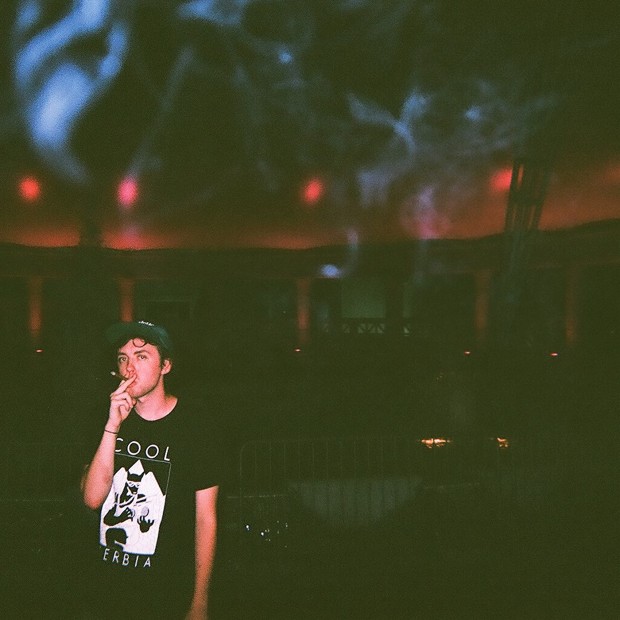
holo pleasures is the sixth release by lo-fi pop project, elvis depressedly and marks the first time under this moniker that there has been a full band effort. The trio that contributed to the record includes Mat Cothran on vocals, drums, and guitar, Eric Jones on guitar and bass, and Delaney Mills playing all the keyboard parts. Like most of Cothran’s work, there is the familiar lo-fi analog comfort layered on top of warbling vocals to create unparalleled mellowness and melancholy.
The first track, okay, a pop number, encompasses Cothran’s simple yet poignant lyrical style including the lyrics, “I remember becoming winter, haunted by light, true love turned to sickness in my body, stayed up all night.” The album has the some of the same vibes as Coma Cinema, Cothran’s other outfit, however what sets them apart is the difference in the coherent aesthetic of the albums. The harmonies and hooks of this release contain a medley of droned keyboard, blown out guitar strumming, and muted percussion followed by refrains such as “If there’s a cool spot in heaven, I know you’ll get in” in weird honey and “Always real, always right, always alright” in pepsi/coke suicide. The six songs that run a total of twelve minutes are meant to be listened as one in order to gain the full experience of the record.
Mat Cothran and his band members are always constantly progressing and a new release is never far away, or from any of the groups in the scene such as Julia Brown, R.L. Kelly, and Pussy Wizard. The casette form of this release is currently sold out, but you can still pick up the 7″ vinyl in either blood red or swamp green from Birdtapes, or give it a listen over at the Bandcamp page.
Standout Tracks: “okay”, “weird honey”, “pepsi/coke suicide”
8.5
“never quit, there’s always a reason to try.”
Tracklisting:
1. okay
2. pepsi/coke suicide
3. inside you
4. teeth
5. weird honey
6. thinning out
Connect